

The Uruguay Paradox

Can a Green Pioneer Drill for Oil?
eyesonuruguay
In the quiet corners of the South Atlantic, a drama is unfolding that could redefine the identity of one of the world’s most progressive energy pioneers. Uruguay, a nation that famously generates nearly 98% of its electricity from renewable sources, is standing at a crossroads. On one side lies the shimmering promise of a “Second Energy Transition” led by green hydrogen; on the other, a deep-sea gamble on offshore oil and gas.
The Green Giant: Renewables and the Carbon Credit Frontier
Uruguay’s climate credentials are not just marketing—they are structural. By 2026, the country has solidified its position as a global leader in the Business of Climate. Having already decarbonized its grid through a massive rollout of wind, solar, and biomass, it is now focusing on the next frontier: Green Hydrogen and Carbon Credits.
The nation is currently launching its first industrial-scale green hydrogen projects, such as the Kahiros initiative, which uses solar power to fuel heavy timber transport. Simultaneously, Uruguay is refining its framework for high-integrity carbon credits. With a unique history of zero net deforestation and a sophisticated digital tracking system for its agricultural sector, the country offers investors something rare in the voluntary carbon market: traceability and trust.
The Offshore Wildcard: A $233 Million Gamble
However, beneath the waves of the Exclusive Economic Zone (EEZ), a different story is being written. After a decade of quiet, the offshore oil industry is back. Global majors including Chevron, Shell, and QatarEnergy have committed over $233 million to exploration programs.
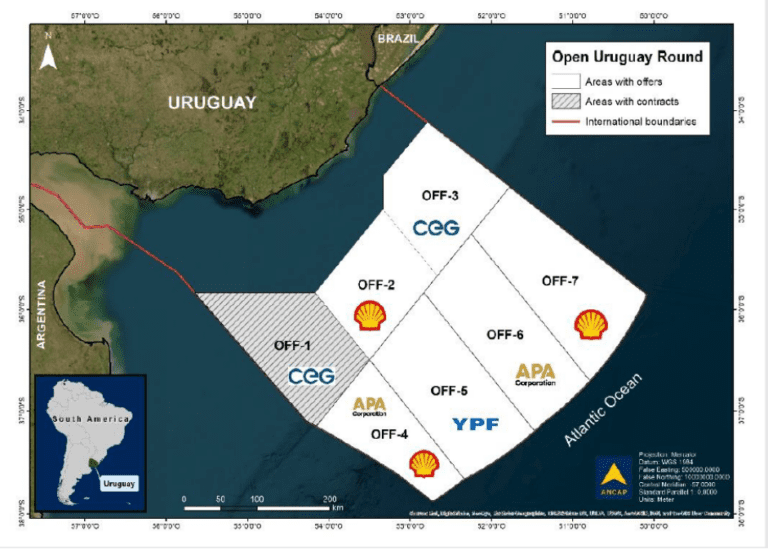
The geological lure? Striking similarities between Uruguay’s seabed and the massive discoveries made recently off the coast of Namibia. If the exploration wells planned for late 2026 and 2027 strike “black gold,” Uruguay could suddenly find itself transitioning from a carbon sink to a fossil fuel exporter.
The Reputation Risk: Can Both Exist?
Critics argue that offshore drilling is a “fossil fuel relapse” that threatens to tarnish Uruguay’s carefully cultivated green image. The “small country” brand is built on being a laboratory for the future—a place where sustainability isn’t just a policy, but a national identity.
“The paradox is striking: the same state-owned entity, ANCAP, that is leading the offshore oil auctions is also the one driving the ‘H2U Offshore’ initiative for wind-powered hydrogen.”
The Counter-Argument: The Uruguayan government views this not as a contradiction, but as a dual-track strategy for energy security and economic sovereignty. They argue that:
- Funding the Transition: Oil revenues could provide the massive capital needed to build out the green hydrogen infrastructure.
- Operational Synergies: The same seismic data and maritime logistics used for oil exploration are being utilized to map sites for massive offshore wind farms.
The Verdict
Uruguay’s “green image” is robust, but it is not invincible. The world is watching to see if a country can truly remain a climate champion while potentially joining the ranks of oil producers. If Uruguay succeeds, it may prove that the transition to a net-zero world is not a sudden stop, but a complex, well-managed evolution. If it fails, it may serve as a cautionary tale about the magnetic pull of old energy in a new world.
What do you think? Should a nation that has already achieved nearly 100% renewable electricity be allowed to explore fossil fuels to fund its future, or does that undermine the very transition it hopes to lead?